



What to Do When a Plumbing Repair Doesn’t Solve the Original Problem
Home /

The water is still leaking. The drain is still slow. The pressure has not returned to normal. You already paid to have the plumbing repaired, yet the original problem is still there.
That does not automatically mean the first repair was done incorrectly.
Sometimes the visible symptom was caused by a different problem nearby. In other cases, the original failure was only one part of a larger plumbing issue. As a plumber in Coeur d’Alene, ID, we look at what changed after the repair, what did not change, and whether the remaining symptom points to another section of the system.
Start With What the Repair Was Supposed to Fix
Before investigating the remaining problem, we establish the original complaint.
Was there a leak? Was the fixture draining slowly? Did a pipe connection fail?
The answer matters because a repair is supposed to address a specific failure. If the original symptom remains unchanged, we need to determine whether the repair addressed the actual source or only one component of a larger problem.
For example, replacing a leaking fitting can stop water escaping from that fitting. It does not necessarily address another leak farther along the same supply line.
Likewise, clearing one section of a drainage system may restore flow temporarily without resolving a restriction farther downstream.
The next investigation should be based on what the system is doing now.
A Persistent Symptom Is New Information
One mistake homeowners can make is treating the unresolved symptom as though nothing has changed. Something has changed.
The repair itself gives us additional information.
If a leak stops but water pressure remains low, we investigate the pressure issue separately. If a drain clears but backs up again shortly afterward, we look for a remaining restriction, a recurring cause, or a problem farther along the drainage system.
The timing can be useful, too.
Did the symptom disappear for several days and then return? Did it improve immediately but never completely? Was there no change at all?
Each pattern points us in a different direction.
The Original Problem May Have Been Larger Than It Appeared
Plumbing systems are interconnected.
A visible failure can sometimes be only the most obvious part of a broader condition. This is especially relevant in older Coeur d’Alene properties where plumbing may have been modified, repaired, or extended over many years.
One section may contain newer piping while another still uses older material. A repair can correct the immediate failure without changing the condition of the rest of the system.
That is why we do not assume that the first repaired component was the only problem.
Look at What Happened After the Repair
The post-repair behavior of the system provides valuable clues.
We ask questions such as:
- Is the symptom exactly the same?
- Is it less severe?
- Did it move to another fixture?
- Does it happen only at certain times?
- Does it occur when another fixture is being used?
- Did the problem return after a period of normal operation?
- Are there new noises, odors, moisture, or pressure changes?
- Does the problem affect one fixture or several?
These details can narrow the investigation considerably.
When the Same Leak Keeps Returning
A recurring leak deserves a closer look.
Replacing the same fitting repeatedly may not solve the underlying problem if movement, corrosion, excessive pressure, deteriorated piping, or another condition is contributing to the failure.
We inspect the surrounding plumbing rather than treating each leak as an isolated event.
For example, if a connection continues to fail, we want to know whether the pipe is under unusual stress or whether another component is causing movement. If corrosion appears around multiple connections, the condition of the broader line becomes more relevant.
When Low Water Pressure Remains
Low pressure after a repair can have several possible causes.
A partially closed shutoff valve is one possibility. A restriction in the plumbing is another. Problems with the pressure-reducing valve, supply piping, or other components can also affect performance.
If the repair involved a particular fixture or pipe, we compare pressure and flow before and after that work where practical.
A localized pressure problem is different from low pressure throughout the house.
Coeur d’Alene homes can also experience seasonal changes in plumbing conditions. Freezing temperatures can affect vulnerable water lines, while older or exposed plumbing may respond differently to winter conditions than newer protected piping.
Weather does not explain every pressure problem, but it is part of the physical context when a symptom appears after a cold period.
When a Drain Is Still Slow After It Was Cleared
A drain that remains slow after a previous repair or cleaning requires a different question.
Where is the restriction?
A blockage close to the fixture can produce one set of symptoms. A restriction farther downstream can affect multiple fixtures. A problem in the main drain or sewer line can produce broader patterns throughout the property.
If a kitchen sink continues to drain slowly after work was performed at the fixture, we look beyond the sink. If multiple bathroom fixtures begin draining slowly at the same time, the problem may be farther downstream.
The location of the symptoms can tell us where to investigate next.
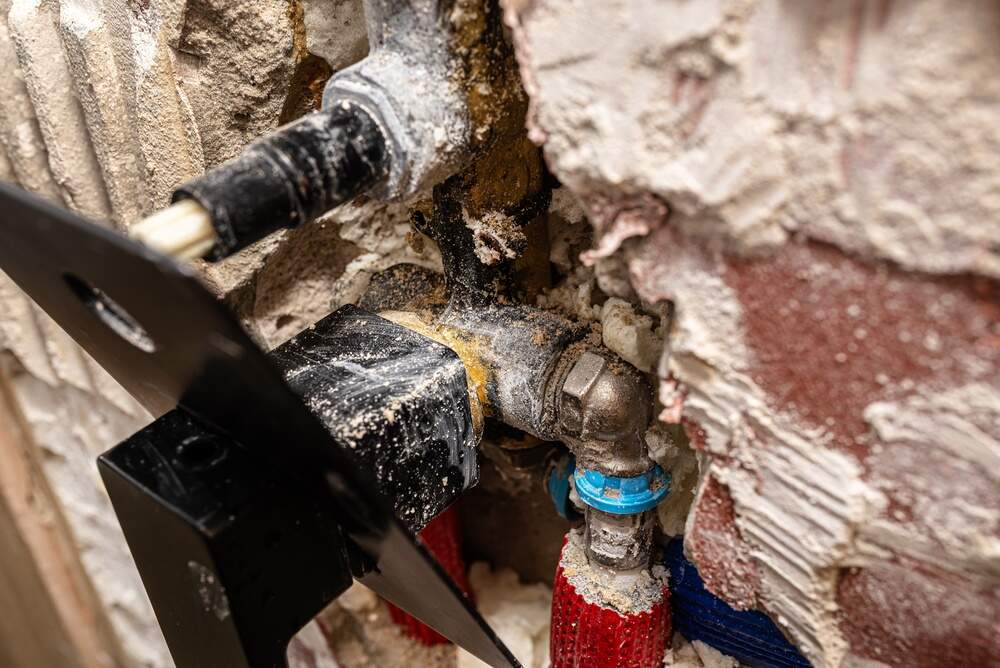
Kitchen and Bathroom Symptoms Can Point Beyond the Fixture
A recurring issue in kitchen plumbing does not necessarily originate at the kitchen fixture.
Grease, food particles, mineral deposits, and other materials can contribute to restrictions, but the actual obstruction may be farther into the branch drain. A recurring backup can also indicate that an earlier repair addressed only part of the problem.
Bathrooms can provide similar clues.
If a bathroom plumbing problem returns after a fixture repair, we want to know whether other fixtures are behaving normally. A toilet, sink, tub, and shower that all develop drainage issues around the same time suggest a different investigation from a single slow drain.
The pattern matters as much as the individual symptom.
What If the Repair Made the Problem Better but Did Not Solve It?
Partial improvement is useful evidence.
Suppose a drain used to stop completely and now drains slowly. The work may have changed the restriction without eliminating the underlying obstruction.
Suppose a leak has gone from a steady drip to occasional moisture. The original failure may have been reduced, but another source may still be present.
We do not consider partial improvement proof that the system is fixed.
Instead, we compare the original and current conditions.
That allows us to determine whether the next step should involve the same component, another section of the system, or a broader diagnostic approach.
Previous Repairs Can Affect the Investigation
Older repairs can tell us a lot about a plumbing system.
We look for replaced sections, different pipe materials, added fittings, patched connections, and modifications that may have changed how the system operates.
A home with decades of plumbing history can have several generations of repairs.
This is particularly useful when investigating recurring failures. If the same area has been repaired multiple times, the repair history may reveal a pattern that is not obvious from the current leak or blockage alone.
Good diagnostics should account for what has already been done.
When the Problem Becomes an Emergency
Not every unresolved plumbing symptom requires immediate service.
A persistent drip may need prompt attention without being an emergency. A recurring slow drain may warrant further diagnosis but may not require after-hours response.
The situation changes when water is actively flooding the property, a major supply line has failed, sewage is entering the home, or another condition presents an immediate risk of property damage.
In those situations, an emergency plumber may be appropriate.
We provide 24/7 emergency plumbing for urgent failures. The immediate priority is controlling the active problem safely, followed by determining why the failure occurred.
Do Not Assume the Second Repair Should Be Identical to the First
We want to know what the first repair changed.
If the first repair did not solve the original symptom, repeating the same repair without new evidence may not be productive.
If replacing one section of pipe had no effect on pressure, we investigate the pressure system. If clearing one drain did not resolve recurring backups, we investigate the downstream piping. If repairing one leak did not stop moisture, we trace the remaining water to its source.
What We Look For During a Follow-Up Investigation
Our process depends on the symptom, but we generally start with the current condition rather than assuming the original diagnosis was complete.
We examine accessible plumbing, compare the current symptoms with the original complaint, check related fixtures where appropriate, and look for evidence that points toward another source.
Our family-operated full-service plumbing company serves homes, businesses, and industrial facilities. Our licensed, bonded, and insured plumbers have more than 30 years of combined plumbing experience, and we provide free estimates along with a full workmanship guarantee.
When You Need a Second Look
If the original symptom remains after a repair, do not judge the situation solely by the fact that money was already spent.
The more useful question is: What does the system tell us now?
The answer may be a separate failure. It may be a problem farther down the line. It may be a recurring condition that was not visible during the first repair. Or the original repair may have corrected one issue while another remained.
A follow-up investigation should account for all of those possibilities.
Frequently Asked Questions
Why is my drain still slow after it was cleared?
The remaining restriction may be farther downstream, or the original work may have only partially cleared the obstruction. Multiple affected fixtures can indicate a problem beyond one individual drain.
Why does a leak keep coming back in the same place?
Recurring leaks can be associated with corrosion, movement, pressure, deteriorated piping, or another condition affecting the connection. The surrounding plumbing should be evaluated rather than repeatedly treating the visible leak alone.
Can cold weather cause a plumbing problem to return?
Freezing temperatures can damage or stress vulnerable plumbing, particularly in exposed or poorly protected areas. A recurring symptom after cold weather should still be investigated rather than automatically attributed to temperature.
When should an unresolved plumbing problem be treated as an emergency?
Active flooding, a major supply-line failure, sewage entering the property, or another rapidly developing condition may require emergency plumbing service.
Find Out Why the Problem Came Back
A plumbing repair that does not solve the original symptom is a reason to investigate further, not simply a reason to keep replacing parts. The remaining leak, slow drain, pressure problem, odor, or backup is giving us new information about what is happening inside the system.
If your plumbing problem returned or never fully went away, contact Straight Shooter Plumbing & Rooter for plumber in Coeur d’Alene, ID service and a closer look at the underlying cause. We offer free estimates, full workmanship guarantees, and 24/7 emergency plumbing services. Call our team when an unresolved problem develops into an active plumbing emergency.
Contact Straight Shooter Plumbing and Rooter Now!
Straight Shooter Plumbing and Rooter is your leading plumber in Idaho, Texas, and Tennessee. Call us or fill out the form to schedule an appointment.